Key takeaways
- Gradual can work. In the 22 trials that compared it with stopping at once, a 2019 Cochrane review found neither gave better long-term quit rates (moderate-certainty evidence).
- Some studies favor stopping on a set day. A 2016 trial, a 2019 analysis of 3 trials and a 2026 study of 27,390 people in England all found better results for quitting abruptly.
- If you cut down, keep it short and fixed. In the 2016 trial, the gradual group cut down by 75% over the 2 weeks before quit day.
- Medicine and support help either way. The US Centers for Disease Control and Prevention (CDC) says adults who smoke have the best chance of quitting for good with medication and counseling together.
A note on our interest: Thin Air is a tapering app, so we have a reason to like the gradual route. The studies below are reported as they are, including the ones that favor stopping on a set day. We have no data of our own on cigarette tapers yet.
Does quitting smoking gradually work?
It can. The question is whether it works as well as stopping at once, and the studies disagree. The Cochrane review also found that the evidence that cutting down beats getting no help at all was inconclusive and very low certainty, so cutting down is a way to reach a quit day, not a treatment in itself.
| Study | Who | What it found |
|---|---|---|
| Cochrane review, 2019 | 22 randomised trials, 9,219 people who smoked, that compared the two routes | Neither cutting down first nor quitting abruptly gave better long-term quit rates. Moderate-certainty evidence. |
| Lindson-Hawley trial, 2016 | 697 adults in English primary care; both groups had nurse support and nicotine replacement | Smoke free at 6 months: 22.0% of the abrupt group, 15.5% of the gradual group. People who preferred cutting down were less likely to be smoke free at 4 weeks than people who preferred stopping (38.3% vs 52.2%). |
| Meta-analysis of 3 trials, 2019 | 1,607 people who smoked; both groups used the same nicotine replacement | Lower prolonged-abstinence rates in the gradual groups (relative risk 0.77). Follow-up length: not stated in the abstract we read. |
| Population study in England (Smoking Toolkit Study), 2026 | 27,390 adults who tried to quit in the past year, 2006 to 2025 | People who chose to quit abruptly had higher odds of success (odds ratio 1.70). People picked their own method, so this shows an association, not cause. |
Lindson-Hawley and colleagues, who ran the 2016 trial, concluded that quitting abruptly "is more likely to lead to lasting abstinence than cutting down first, even for smokers who initially prefer to quit by gradual reduction". The Cochrane review, which pools many more trials, found no clear winner. The 2016 trial and the 3-trial analysis are the kind of trials the Cochrane review pooled (its search ran to October 2018), so read them as single studies inside a mixed picture, not as a second verdict. Cutting down first is a real option.
How do you cut down on cigarettes before quit day?
People also call this weaning off cigarettes or cutting back before a quit date. If cutting down is how you will start, here is how it was done in the trials. The trials that tested cutting down had a few things in common. Each step below comes from them or from a health agency.
- Pick your quit day first, and make it close. Smokefree.gov says to choose a quit date "no more than a week or two away", because a date too far off gives you time to change your mind. In the 2016 trial, the gradual group cut down over the 2 weeks before quit day. Cutting down with no quit date was not what these trials tested; Cochrane only included trials where the goal was to stop altogether.
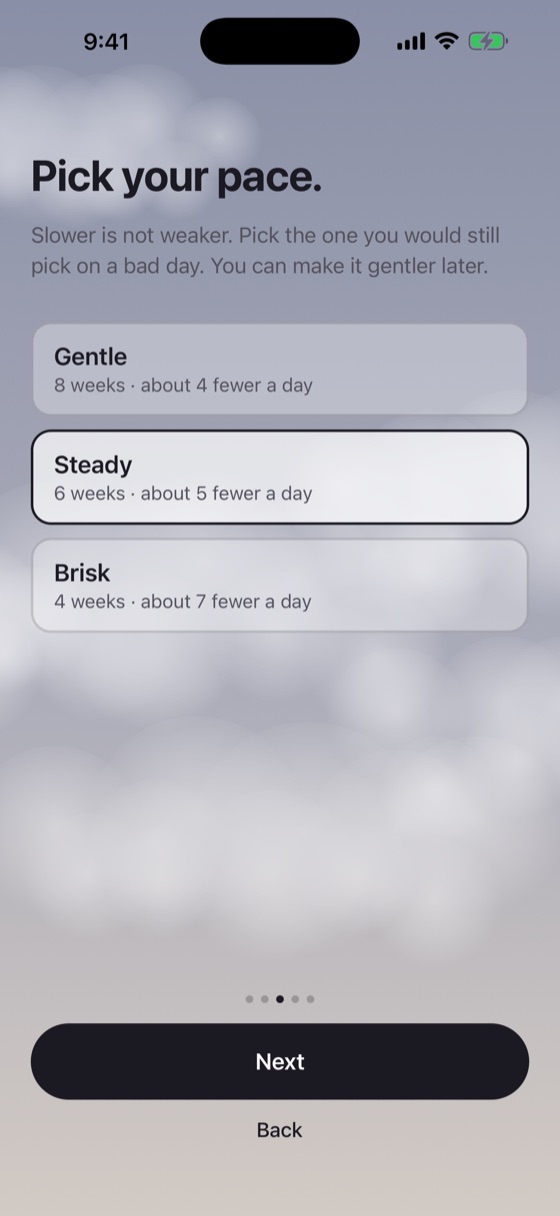
- Cut down on a schedule. In that trial, people cut down by 75% in those 2 weeks. For someone on 20 a day, that is about 5 a day by the night before quit day (our arithmetic from the trial's 75% figure; the trial abstract does not give the daily steps). A day-by-day limit makes the schedule concrete: the free taper planner works for cigarettes. It offers 4, 6 or 8 weeks, longer than the 2 weeks tested, and no source we checked says which length works best.
- Ask about stop-smoking medicine. The Cochrane review found low-certainty evidence that cutting down may work better with medicine as an aid, particularly fast-acting nicotine replacement or varenicline. Smokefree.gov says nicotine replacement can double your chances of quitting for good. A pharmacist or doctor can tell you what fits you. We don't give dosing advice.
- Get support. Both groups in the 2016 trial had nurse support. The CDC says adults who smoke have the best chance of quitting for good "when they use medication and counseling together". Free help: 1-800-QUIT-NOW in the US (CDC), or your local Stop Smoking Service in the UK, whose advisers offer free advice and help (UK National Health Service, NHS).
- Know how dependent you are. The NHS says smoking within 30 minutes of waking, finding the first cigarette of the day the hardest to give up, or smoking even when you're ill in bed are signs of stronger dependence. If that's you, it says expert support and stop-smoking products will boost your chances.
Cutting down first is also how some people who vape have quit. From an App Store review of a puff-counting app:
"This app helped me quit with relative ease by slowly scaling back in a manageable way."
App Store review, October 2021
Does cutting down cause withdrawal before you quit?
Not more than you might fear. The 2019 Cochrane review found the data sparse, but the available data "suggested no excess" of withdrawal symptoms before quit day in people who cut down first. After quit day, the NHS says you may feel a strong urge to smoke, irritable or restless, and tense or low in mood. Our guide to the side effects of quitting vaping lists these symptoms with timelines that come from smoking studies, and how long nicotine cravings last covers getting through one.
What changes when you stop smoking?
The NHS says you'll notice some benefits within days or weeks: your senses of taste and smell improve, you start to breathe more easily, and you have more energy. It says that after 1 year your risk of heart attack halves compared to a smoker's, and after 10 years your risk of death from lung cancer falls to half that of a smoker.
Frequently asked questions
Is it better to quit smoking gradually or cold turkey?
The evidence is mixed. A 2019 Cochrane review of the 22 trials that compared them found neither gave better long-term quit rates, while a 2016 trial and a 2026 study in England found better results for quitting abruptly. Most guidelines advise stopping on a set day (the 2016 trial authors and the Cochrane review both note this), and some studies favor it. If you can do that, do it. We compare both in cold turkey vs tapering.
How long should cutting down take?
In the 2016 trial, 2 weeks. Smokefree.gov says to pick a quit date no more than a week or two away. No source we checked names a best taper length.
Should I switch to vaping to cut down?
Health agencies differ in tone. The NHS says nicotine vapes are one of the most effective stop-smoking products. The CDC says e-cigarettes may have the potential to benefit adults who smoke and are not pregnant, if used as a complete substitute for all smoked tobacco products, and that using both may mean greater exposure to toxins and worse respiratory health than either alone. The CDC also notes the FDA has not approved any e-cigarette to help people quit smoking. If you switch, the NHS says that once you're sure you won't go back to smoking, you can cut down your vaping until you have stopped.
What if I don't get to zero the first time?
That is common. Chaiton and colleagues, who followed 1,277 people in the Ontario Tobacco Survey who tried to quit smoking, concluded in 2016 that for many smokers "it may take 30 or more quit attempts before being successful". More on the timeline in how long it takes to quit vaping.
Sources (checked 2 and 3 November 2026)
- Lindson N, Klemperer E, Hong B, Ordóñez-Mena JM, Aveyard P. Smoking reduction interventions for smoking cessation. Cochrane Database of Systematic Reviews, 2019.
- Lindson-Hawley N, et al. Gradual versus abrupt smoking cessation: a randomized, controlled noninferiority trial. Annals of Internal Medicine, 2016.
- Tan J, Zhao L, Chen H. A meta-analysis of the effectiveness of gradual versus abrupt smoking cessation (3 randomised trials). Tobacco Induced Diseases, 2019.
- Are there differences in gradual versus abrupt smoking cessation quit attempts and success by social grade? A population study in England. Drug and Alcohol Dependence, 2026.
- Chaiton M, et al. Estimating the number of quit attempts it takes to quit smoking successfully in a longitudinal cohort of smokers. BMJ Open, 2016.
- Smokefree.gov (National Cancer Institute). Prepare to Quit.
- NHS Better Health. Should I quit smoking cold turkey?
- NHS Better Health. Benefits of quitting smoking.
- NHS Better Health. Vaping myths and facts.
- CDC. Vaping and Quitting.
- CDC. Health Effects of Vaping.
Thin Air is a self-tracking app, not a medical service. This page is general information, not medical advice. If low mood turns into thoughts of harming yourself, in the US call or text 988 (988 Lifeline).